AI in the Workplace: The Promise, the Pitfalls, and How We Can Take the Lead
Door Lianne Ilsink
AI in the Workplace: The Dream, the Drama, and Staying in the Driver’s Seat
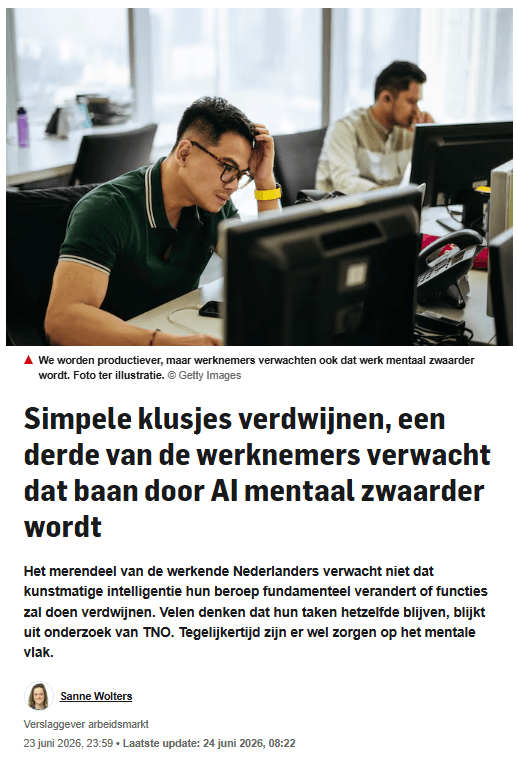
**AI has two faces. On the one hand, it helps us become more efficient, but on the other hand, it can also make us deeply uncertain. Also read the article (and use AI to translate it into English 😉) AD about the recent large-schale study by TNO. "Simple tasks are disappearing, while one in three employees expects their work to become mentally more demanding because of AI".
At InnovateU, we share this perspective. We do not believe that AI should be viewed as a holy grail that will replace people. AI is not an end in itself; it is an incredibly powerful digital toolkit that makes you smarter and more capable. However, to use these tools effectively, and without unintended consequences, we must put people back at the center. Technology should empower human potential, not replace it. By keeping the human element at the heart of AI adoption, we can harness its benefits while preserving the creativity, empathy, judgment, and connections that make us uniquely human.
So, how do we make that happen? Not with vague presentations or buzzwords, but with a clear and practical three-part roadmap.
1. The Assessment & the Compass: Never Navigate Blind Again
Right now, many organizations are navigating the AI transition without a clear course. “We need to do something with AI,” management declares, and before long, new software is being purchased without a clear strategy. The result? Frustration, uncertainty, and performance anxiety among employees.
At InnovateU, we break this cycle with two practical instruments:
-
The Assessment (The Baseline Measurement): Before we start running, we first determine where we stand. How digitally literate are we as individuals and as a team? But equally important: do we as an organization have a clear vision and direction for where we want to go?
-
The Compass (The Direction): While the assessment determines the starting point, the compass defines the destination. It answers a fundamental question.
Let's be honest: If management is using AI as a hidden strategy to reduce headcount, employees will sense it immediately. A compass only works when everyone is moving in the same direction. Technology should be used to create more time for innovation, creativity, and meaningful human interaction, not to make people obsolete. Clarity upfront prevents fear later. When people understand the purpose behind AI adoption, uncertainty gives way to trust, engagement, and a shared sense of direction.
2. Continuous Self-Reflection: Preventing AI Burnout
Did you know that 33% of employees fear mental exhaustion due to the rapid pace of technological change? That is not a statistic we can afford to ignore.
A one-time training session in the cafeteria is not going to solve this challenge. The reality is that change is continuous, so our ability to monitor and adapt to that change must be continuous as well.
-
The Self-Reflection Loop: Through accessible pulse checks and digital journals, employees regularly check in with themselves. "How am I really doing?", "Am I still engaged and energized by my work?", "Do I feel confident about the changes around me?"and "Is my workload becoming too high?
-
"Proactive Guidance: This is explicitly not a Big Brother-style monitoring tool for management. Instead, it acts as a personal compass for employees. "Am I keeping pace with the ambitions of the organization?", "What skills should I further develop?", "Where are my opportunities for growth?" and "Am I being honest with myself about my strengths and challenges?".
3. Developing Adaptability: Your Human Skills Are Your Superpower
If AI takes over the repetitive, predictable, and "easy" tasks, what is left for us? Exactly: the truly human work. Adding nuance. Bringing emotion and meaning. Thinking creatively beyond conventional boundaries. Sparking ideas that set entire chains of innovation in motion. Now more than ever, we must excel at the skills that no algorithm will ever possess. It is these uniquely human capabilities—creativity, empathy, critical thinking, judgment, and connection—that will set us apart and create lasting value in an AI-driven world.
InnovateU spotlight's on Four Essential Human Skills:
- Human-Centered Leadership: leading through trust, empowerment, and outcomes rather than digital micromanagement. Creating a safe environment where making mistakes is accepted as part of the learning process—because that is often where the greatest growth happens.
- Collaboration & Integration: The more we communicate with systems, the better we need to communicate with each other. Co-creation, teamwork, and solving complex human challenges become increasingly important in an AI-driven workplace.
- Critical Data Literacy: AI generates a tsunami of data, insights, and recommendations. The human role is to act as the filter: Is this actually correct? What biases might be embedded in the data or the algorithm? Decisions should be guided by critical thinking, sound judgment, and collaborative discussion, not by AI alone.
- Continuous Improvement: developing an agile and adaptable mindset. Learning how to use AI as the ultimate assistant to make your work more enjoyable, more intelligent, and more challenging. The goal is not simply to adapt to change, but to continuously learn, improve, and grow alongside it.
The Conclusion: You Are the Pilot, AI Is the Co-Pilot
The future of work is not digital, it is hybrid. The winners of tomorrow will not be the companies with the most expensive software, but the companies that best support their people through this transformation.
💡 Wisdom: Technology is exciting, but keeping the wheels turning is still a people business.